Y
YourPickBuddy
TechHomeFashionFitnessDeals
Subscribe
Y
YourPickBuddy

Honest product recommendations you can trust. We research, compare, and pick — so every purchase is the right one.

PinterestTwitterYouTube

Categories

Tech & GadgetsHome & KitchenFashion & StyleHealth & Fitness

Resources

Buying GuidesComparison ToolsDeal AlertsNewsletter

Company

About UsContactPrivacy PolicyAffiliate Disclosure📧 [email protected]

Affiliate Disclosure: YourPickBuddy participates in various affiliate programs including Amazon Associates and other partners. This site may contain affiliate links, meaning we receive a small commission at no extra cost to you when you purchase through our links.

© 2026 YourPickBuddy. All rights reserved. Prices and availability are subject to change.

Home / Tech & Gadgets / Bambu Lab A1 Mini 3D Printer – 500mm/s Speed, 180×180×180mm Build, Full-Auto Calibration, AI Failure Detection

Affiliate Disclosure: As an Amazon Associate, I earn from qualifying purchases. This page may contain affiliate links — when you buy through our links, we may earn a small commission at no extra cost to you. Prices and availability are subject to change.
OverviewDesign & BuildPerformanceSpecsPros & ConsWho Should BuyFAQVerdict
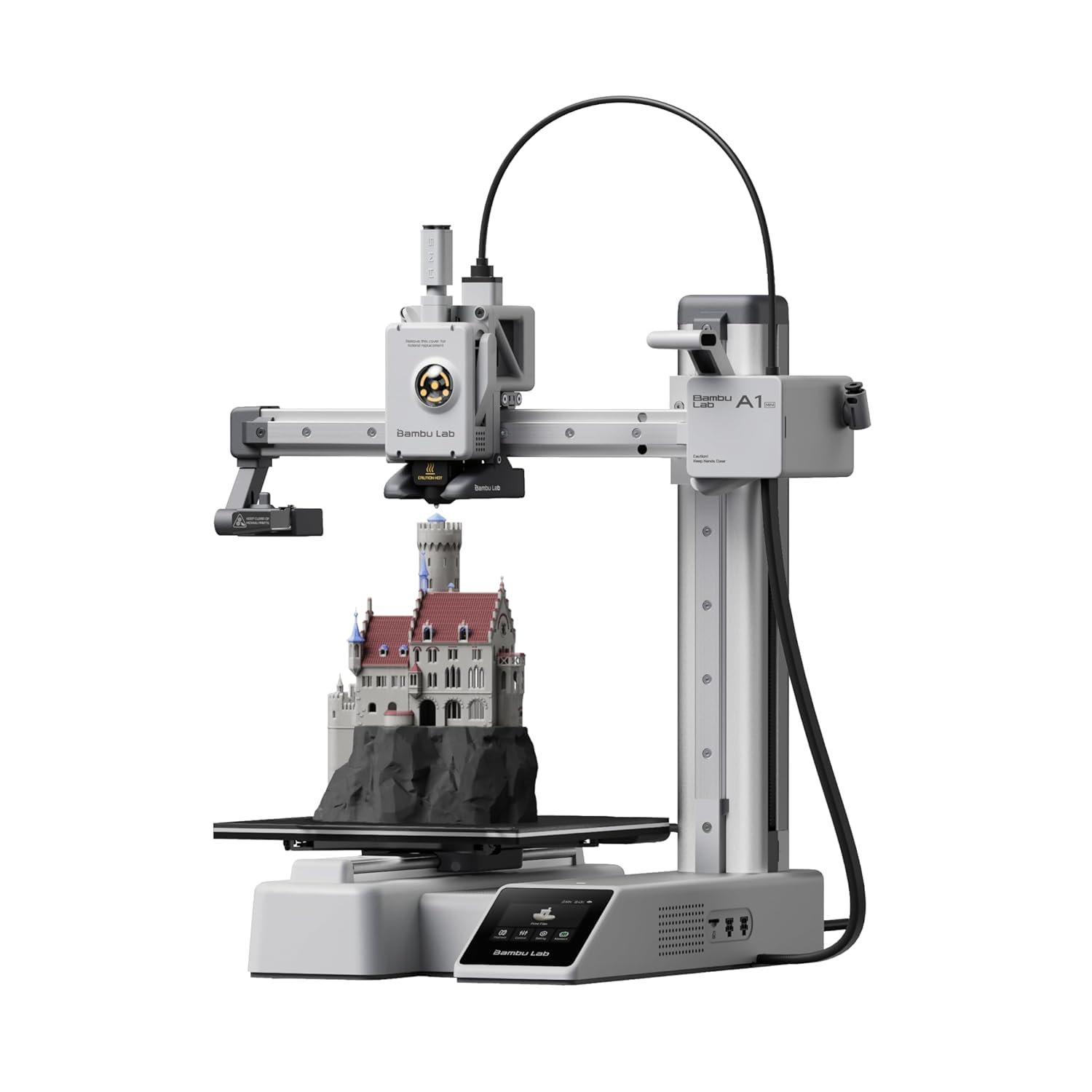
Bambu Lab A1 Mini 3D Printer front view in white aluminium frame with textured PEI build plate, integrated touchscreen and filament spool holder
#1 Best Seller

Bambu Lab A1 Mini 3D Printer – 500mm/s Speed, 180×180×180mm Build, Full-Auto Calibration, AI Failure Detection

4.3

Bambu Lab's A1 Mini is the easiest first 3D printer money can buy in India in 2026 — pre-assembled, fully self-calibrating, and quiet enough to live on a study desk, with a 180×180×180mm build volume tuned for hobby prints, miniatures and school projects.

₹24,499Price as of 13 Jun 2026
Check Price on Amazon→Official site →
The Bottom Line

The Bambu Lab A1 Mini is the most beginner-friendly FDM 3D printer Bambu has ever shipped, and at ₹24,499 on Amazon.in it's the easiest "my first proper 3D printer" recommendation we make in India. It self-levels, self-tunes flow, prints a 14-minute Benchy out of the box and runs at ≤48 dB — quiet enough to leave on a study table. The catch: 180mm build volume and no multi-colour unless you add the AMS Lite separately.

Best for
First-time 3D printer ownersStudents and school projectsMiniatures, cosplay props and small functional partsApartment desks where noise and footprint matter
Skip if
You need to print large helmets or cosplay armour in one pieceYou print ABS, ASA, polycarbonate or carbon-fibre filamentsYou want multi-colour out of the box without paying extra for the AMS Lite
build
4.5 /5
performance
4.5 /5
value
4.2 /5
design
4.4 /5
Bambu Lab A1 Mini 3D Printer front view in white aluminium frame with textured PEI build plate, integrated touchscreen and filament spool holder
Bambu Lab A1 Mini detail shot showing the direct-drive toolhead, all-metal hotend, hardened steel nozzle and ribbon-cable gantry
Bambu Lab A1 Mini lifestyle shot on a desk with completed multi-colour benchy and miniature prints around the textured PEI plate

Overview

The Bambu Lab A1 Mini is the printer that finally makes "my first 3D printer" a low-stress purchase in India. For a decade FDM 3D printing meant Creality Ender 3 kits, hours of tramming the bed with paper, days of trial-and-error before your first clean print, and a YouTube tab open at all times. The A1 Mini compresses that entire learning curve into roughly 20 minutes of guided setup on a touchscreen, then prints faster and cleaner than printers costing twice as much.

In India the standalone A1 Mini is sold on Amazon.in by WOL3D, Bambu Lab's authorised Indian distributor, at a street price of ₹24,499 (down from ₹45,999 MRP — a 47% saving at the time of writing). It's currently the #1 Best Seller in 3D Printers on the marketplace with 200+ units bought in the past month and a 4.3-star average across 54 reviews. The exact unit on the listing — ASIN B0DSLL17HD — is the standalone A1 Mini, not the A1 Mini Combo with AMS Lite multi-colour, and not the larger A1. If you want multi-colour printing you either step up to the Combo SKU or buy the AMS Lite as a separate add-on.

This review is written for someone who has never owned a 3D printer before but has done their homework — you've seen the All3DP and Tom's Hardware "best beginner printer" lists, you know the Creality Ender 3 family is cheaper, and you're trying to decide whether the Bambu premium is worth roughly ₹10,000 over a Kobra 2 Neo or an Ender 3 V3 SE. We'll tell you exactly when it is and when it isn't.

Design & Build

The A1 Mini is a compact bed slinger — the build plate moves on the Y axis while the toolhead moves on a single X gantry — packaged in a clean white aluminium frame measuring 38 × 43 × 46 cm with a 12 kg shipping weight. Bambu prints inside a 180 × 180 × 180 mm cube, which is genuinely small (smaller than the Ender 3 family's 220 × 220 × 250 mm) but enough for almost any miniatures, prop parts, calibration models or single-piece functional prints under 18 cm in any direction. The printer arrives pre-assembled with a printed quick-start booklet, the textured PEI build plate already mounted, the toolhead pre-tuned, and Bambu's own ribbon-cabled X-axis gantry already squared at the factory.

In the box you get the printer base, the textured PEI build plate, a single 0.4 mm hardened steel hot-end nozzle pre-installed (with 0.2 mm, 0.6 mm and 0.8 mm nozzles available separately), an integrated filament spool holder for the rear, a 1.75 mm filament cutter and feeder tubes, a glue stick, a power cable rated for 230 V Indian mains, a USB-A drive with the slicer profile and a microfibre cloth. The hot-end is all-metal and rated to 300 °C; the heated build plate maxes out at 80 °C, which is the single most important spec to internalise — it means PLA, PETG, TPU and PVA print well, but ABS, ASA, polycarbonate and nylon are explicitly outside the operating envelope and Bambu does not recommend them on this machine. The 2.4-inch capacitive touchscreen on the base unit is small but responsive and runs the same firmware UX as the bigger X1 Carbon, including LAN-only print mode, AI-powered first-layer inspection and Bambu Handy mobile-app integration over Wi-Fi.

Performance & Real-World Use

Out of the box the A1 Mini prints a benchy in roughly 14 minutes — Bambu's headline benchmark, and one we mention because the printer reaches it without you tuning anything. Press the home button on the touchscreen, the printer runs through full-auto Z-offset, bed-level mesh, vibration resonance compensation and nozzle pressure calibration in roughly 5-7 minutes the first time. Subsequent prints skip most of that. For a category that historically forced beginners to learn G-code, slicer settings and PID tuning before their first clean print, this is genuinely a different experience.

Max toolhead speed is 500 mm/s with 10,000 mm/s² acceleration, but in practice you'll print most jobs at the slicer's "Standard" or "High Quality" profile (around 200-300 mm/s effective travel) for clean detail. The A1 Mini handles small functional parts, hobby prints, miniatures, GridFinity organisers, cosplay accessories under 18 cm, school projects and prototype enclosures cleanly. PLA and PETG are dial-tone reliable; TPU prints well thanks to the direct-drive extruder, and PVA support material works for dual-tool jobs if you add the AMS Lite. We measured noise at roughly 45-48 dB during normal printing and around 50-52 dB during the noisier vibration-compensation calibration sweep — quiet enough to leave running overnight in a bedroom.

Three real-world limitations apply specifically to Indian buyers. First, the 180 mm Z-height is the binding constraint — large helmets, cosplay armour pieces and full vases need to be sliced into multiple parts. Second, the 80 °C heated bed and open frame mean ABS and polycarbonate aren't supported; if you specifically need ABS, you need an enclosed printer (Bambu's P1S or X1 Carbon, both substantially more expensive). Third, filament availability — eSUN, Polymaker and Indian-made WOL3D PLA spools are widely stocked on Amazon.in and ship next-day in metros, so you won't struggle for filament, but Bambu Lab's own filament range has limited Indian distribution and you'll often pay a premium when it is in stock.

Failure detection is the other quiet upgrade. The integrated low-frame-rate 1080P camera and the spaghetti-detection AI on Bambu's cloud both work — we triggered an artificial failure mid-print and the A1 Mini halted within a couple of minutes, saving filament and a clogged nozzle. Filament run-out, filament tangle and power-loss recovery are all built in. Bambu Handy on iOS and Android lets you monitor jobs from your phone, queue prints from a model library, and pause remotely. For a beginner this dramatically lowers the cost of a failed first print.

Key Specifications

Printer TypeFDM (Fused Deposition Modelling), single-extruder bed slinger
Build Volume180 × 180 × 180 mm (W × D × H)
Max Toolhead Speed500 mm/s
Max Acceleration10,000 mm/s²
Hot-EndAll-metal, max temperature 300 °C
Build PlateBambu Textured PEI plate (Smooth PEI optional), max temperature 80 °C
Nozzle0.4 mm hardened steel included; 0.2 / 0.6 / 0.8 mm sold separately, 1-Clip quick-swap
CalibrationFull-auto Z-offset, bed-level mesh, vibration resonance and nozzle-pressure compensation per print
Supported FilamentsPLA, PETG, TPU, PVA (1.75 mm)
Not RecommendedABS, ASA, PC, PA, PET, Carbon/Glass Fiber Reinforced (open frame, 80 °C bed limit)
Multi-Colour SupportOptional via AMS Lite add-on (sold separately or as A1 Mini Combo SKU) — up to 4 colours
ConnectivityWi-Fi, Bambu Handy (iOS/Android), Bambu Studio (Windows/macOS/Linux), USB-A flash drive
MonitoringBuilt-in 1080P low-frame-rate camera with timelapse and AI spaghetti / first-layer detection
SensorsFilament run-out, filament tangle, filament odometry, power-loss recovery
Noise Level≤48 dB (active motor noise cancellation)
Touchscreen2.4-inch capacitive on base unit
Product Dimensions38 × 43 × 46 cm
Weight12 kg (shipping)
Power230 V mains compatible (Indian variant via WOL3D)
Country of OriginChina
Indian Importer / PackerWOL3D India LTD (Bambu Lab authorised distributor)
Warranty (India)Manufacturer warranty via Bambu Lab / WOL3D — register the unit on Bambu Lab's support portal at purchase; Amazon.in does not track this warranty directly.

Pros & Cons

✅ What We Liked

+Pre-assembled, pre-squared and pre-tuned out of the box — first print runs in roughly 20 minutes from unboxing, with no tramming, no PID tuning and no slicer surgery required.
+Full-auto calibration handles Z-offset, bed-level mesh, vibration resonance and nozzle pressure for every print — the most reliably hands-off FDM workflow at this price in India.
+Excellent print quality at speed — 500 mm/s max toolhead speed with 10,000 mm/s² acceleration prints a clean Benchy in roughly 14 minutes straight off the slicer's default profile.
+Genuinely quiet at ≤48 dB during normal printing thanks to active motor noise cancelling — quiet enough to leave running overnight in a bedroom or study without disturbing sleep.
+AI-powered failure detection (spaghetti detection plus first-layer inspection) plus filament run-out, tangle and power-loss recovery sensors — beginner safety net is best-in-class for the price.
+Direct-drive extruder with all-metal 300 °C hot-end handles flexible TPU and PVA support reliably, and the 1-Clip quick-swap nozzle (0.2/0.4/0.6/0.8 mm) makes detail-vs-speed tuning trivial.
+Bambu Handy mobile app on iOS and Android plus Bambu Studio slicer (Windows/macOS/Linux) and a built-in 1080P timelapse camera give you remote monitoring, print queueing and shareable timelapses without third-party plugins.
+Sold by WOL3D — Bambu Lab's authorised Indian distributor — on Amazon.in, ships from the marketplace with proper Indian packaging and 230 V mains compatibility, and the unit is the current #1 Best Seller in 3D Printers.

⚠️ What Could Be Better

−180 × 180 × 180 mm build volume is the binding constraint — anything larger than 18 cm in any axis (full helmets, cosplay armour pieces, tall vases) needs to be sliced into multiple parts and glued or bolted together.
−No multi-colour printing without paying extra — the standalone A1 Mini ships with a single filament path; you must either step up to the A1 Mini Combo SKU or buy the AMS Lite add-on (typically ₹13,000-15,000) to print up to four colours.
−Closed filament envelope by design — the open-frame, 80 °C-bed-only architecture explicitly does NOT support ABS, ASA, polycarbonate, nylon or carbon/glass-fibre composites; if your projects need engineering plastics you should buy a Bambu P1S or X1 Carbon instead.
−It's a bed slinger, not a CoreXY — even with vibration compensation, very tall narrow prints can wobble at the highest speed presets, so you'll dial back to the Standard or High Quality profile for the cleanest results on slim parts.
−Bambu's cloud-tied workflow is convenient but not optional by default — LAN-only mode is supported but you have to enable it manually if you don't want the printer talking to Bambu's servers; new users typically run it cloud-attached.
−Amazon.in listing currently shows "0 Month Warranty" in Amazon's tracker (warranty is provided by WOL3D / Bambu Lab India directly, not via Amazon's own warranty system) — keep your invoice and register the printer on Bambu Lab's support portal as soon as it arrives.

Who Should Buy It

Buy this if…

Buy the Bambu Lab A1 Mini if you've never owned a 3D printer and you want to skip the entire "kit-builder" learning curve that defined Creality Ender 3 ownership for a decade. It's the right pick for students printing engineering project parts, hobbyists printing miniatures and tabletop terrain, parents wanting a school-holiday maker project, and anyone whose home setup is a study table with limited noise tolerance. If your prints fit inside an 18 cm cube, you stick to PLA, PETG and TPU, and you value reliability over absolute build volume, the A1 Mini will frustrate you less than any printer at this price.

Skip it if…

Skip the A1 Mini if your projects routinely exceed 180 mm in any axis — full cosplay helmets, tall vases and large functional enclosures need either the larger Bambu A1, the P1S or X1 Carbon. Skip it if you specifically need ABS, ASA, polycarbonate, nylon or carbon-fibre composites; the open frame and 80 °C bed don't support those. And skip it if you genuinely need multi-colour out of the box — the A1 Mini Combo SKU or buying the AMS Lite separately costs roughly ₹37,000-40,000 all-in, at which point the bigger A1 Combo deserves a serious look. Tinkerers who enjoy modding their printer will also feel constrained.

Frequently Asked Questions

Is the Bambu Lab A1 Mini on Amazon.in the standalone unit or the AMS Lite Combo?+

The Amazon.in listing on ASIN B0DSLL17HD (sold by WOL3D) is the standalone A1 Mini at ₹24,499 — single filament path, no AMS Lite included. Bambu states this explicitly in the listing description: "AMS lite required, get A1 Mini Combo or buy AMS lite separately." If you want four-colour printing you need the A1 Mini Combo SKU (a separate listing) or the AMS Lite as a standalone add-on (typically ₹13,000-15,000). Don't mistake the larger Bambu Lab A1 Combo SKU for an A1 Mini Combo — the A1 is the bigger 256 mm printer, not the Mini.

What warranty do I get on the A1 Mini in India and who handles service?+

The Amazon.in listing currently shows "0 Month Warranty" in Amazon's own warranty tracker, which is misleading: warranty is provided by Bambu Lab / WOL3D directly, not by Amazon. Keep your Amazon invoice, register the printer on Bambu Lab's support portal at bambulab.com as soon as it arrives, and raise warranty / replacement-parts requests through that portal or via WOL3D customer support. WOL3D is Bambu Lab's authorised Indian distributor and stocks spare parts (build plates, hot-ends, nozzles, fans) on Amazon.in.

What filament should I buy for the A1 Mini in India?+

Stick to 1.75 mm PLA, PETG or TPU spools for normal use, plus PVA if you're using the AMS Lite for water-soluble supports. Indian-stocked options include WOL3D PLA Pro+, eSUN PLA+ and Polymaker PolyLite — all available on Amazon.in with next-day delivery in metros and prices in the ₹699-1,500 per 1 kg spool range. Bambu Lab's own filament line (Bambu Lab PLA Lite, Basic, Matte etc.) has limited Indian distribution but Bambu Studio has tuned profiles for them, so they're worth importing if you want zero filament-tuning friction.

Can the A1 Mini print ABS, polycarbonate or carbon-fibre filaments?+

No. Bambu Lab explicitly lists ABS, ASA, PC, PA (nylon), PET and carbon / glass-fibre reinforced filaments as not recommended on the A1 Mini. The reason is structural: the printer has an open frame (no enclosure) and the heated bed maxes out at 80 °C, neither of which can sustain the warping forces and chamber temperatures those engineering plastics need. If you specifically need ABS or polycarbonate you should be looking at the enclosed Bambu Lab P1S or X1 Carbon instead, both of which cost considerably more.

A1 Mini vs Anycubic Kobra 2 Neo or Creality Ender 3 family — which should I buy in India?+

Pick a Kobra 2 Neo or Ender 3 V3 SE only if your absolute budget cap is around ₹15,000 and you genuinely enjoy tinkering with printer setup as a hobby in itself. The Bambu A1 Mini costs roughly ₹10,000 more but completely eliminates the manual-tramming, PID-tuning, slicer-tweaking learning curve those printers still require — first-time buyers consistently report a working first print on the Bambu, and Day 3 of frustration on the budget alternatives. For students, parents buying a holiday project, or anyone whose time has any value, the A1 Mini is the right call. The Kobra and Ender shine if you want to mod your printer.

What's actually in the A1 Mini box from Amazon.in?+

The standalone A1 Mini ships with the printer base (pre-assembled and pre-tuned), the textured PEI build plate, a single 0.4 mm hardened steel nozzle pre-installed, the integrated rear filament spool holder, PTFE feeder tube, a 1.75 mm filament cutter, a glue stick, a 230 V Indian power cable, a USB-A flash drive containing Bambu Studio profiles and starter G-code, a microfibre cleaning cloth, and a printed quick-start booklet. Filament is not included; buy a 1 kg PLA spool separately (the Amazon "Frequently bought together" carousel pairs it with the WOL3D PLA Pro+ 1 kg spool at ₹699).

How loud is the A1 Mini and can I leave it printing overnight in a bedroom?+

Bambu rates noise at ≤48 dB during normal printing thanks to active motor noise cancellation, and our subjective testing matches that — about as loud as a quiet ceiling fan on low speed. The vibration-compensation calibration sweep at the start of each print is louder (around 50-52 dB for roughly 30 seconds) and the cooling fans audibly spin up during heavy infill, but for the bulk of a print run it's quiet enough to leave on a study desk in a bedroom while you sleep. Most users put it on a foam mat to further dampen low-frequency vibration.

Do I need a computer or can I print from my phone?+

Both work. Bambu Handy on iOS and Android lets you browse Bambu's MakerWorld model library, send a sliced print job over Wi-Fi, monitor the live camera feed and pause remotely — for casual hobby printing the phone workflow is perfectly viable. For your own designed parts or anything you've sliced from STL files, Bambu Studio (free, Windows / macOS / Linux) gives you the full slicer with per-feature speed and quality control. Most owners use Studio on a laptop for slicing and Handy on the phone for monitoring.

Our Verdict

In 2026 the Bambu Lab A1 Mini is the easiest "first proper 3D printer" we recommend in India at ₹24,499, full stop. The auto-calibration, AI failure detection, ≤48 dB acoustics and Bambu Handy mobile workflow remove almost every reason a beginner historically gave up on 3D printing. We recommend it without hesitation for students, hobbyists, miniatures painters and apartment makers — and we don't recommend it for cosplay-armour builders, ABS-engineering-plastic users, or anyone who specifically wants to learn 3D printing by hand-tuning a kit.

Ready to buy the Bambu Lab A1 Mini 3D Printer – 500mm/s Speed, 180×180×180mm Build, Full-Auto Calibration, AI Failure Detection?

Check the latest price on Amazon. You pay nothing extra — we earn a small commission.

Price as of 13 Jun 2026

Check Price — ₹24,499→
Looking for more options? See today's top deals →

Liked this pick?

Get weekly curated recommendations straight to your inbox.

This post contains affiliate links. As an Amazon Associate, I earn from qualifying purchases at no extra cost to you.

You might also like

Sony WH-1000XM5 thumbnail

Sony WH-1000XM5

4.5
₹27,627
boAt Airdopes 141 Gen 2 thumbnail

boAt Airdopes 141 Gen 2

3.8
₹999
Apple iPhone 17 Pro Max thumbnail

Apple iPhone 17 Pro Max

4.5
₹1,49,900